
Dutch technology company Next Generation Machinery (NGM) is preparing to launch a world-first innovation that could accelerate the transition to zero-emission construction and agriculture. Later this year, the company will introduce the MOOSE Powerunit: a compact power generator that converts renewable methanol into electricity, delivering an impressive 100 kW of continuous power.
Renewable methanol, advanced fuel cell technology and Dutch engineering combine to deliver 100 kW of clean off-grid power for construction and agriculture.

For comparison, most commercially available clean mobile generators currently produce just 4–5 kW. According to NGM co-founder Ruud Bakker, the difference is significant. “A single MOOSE Powerunit can supply enough electricity for four heavy construction machines during a full working day. That level of power simply doesn’t exist in a system this compact.”
After eight years of research and development, NGM is now completing the final testing and validation phase before bringing the technology to market.
A new generation of Mobile Power
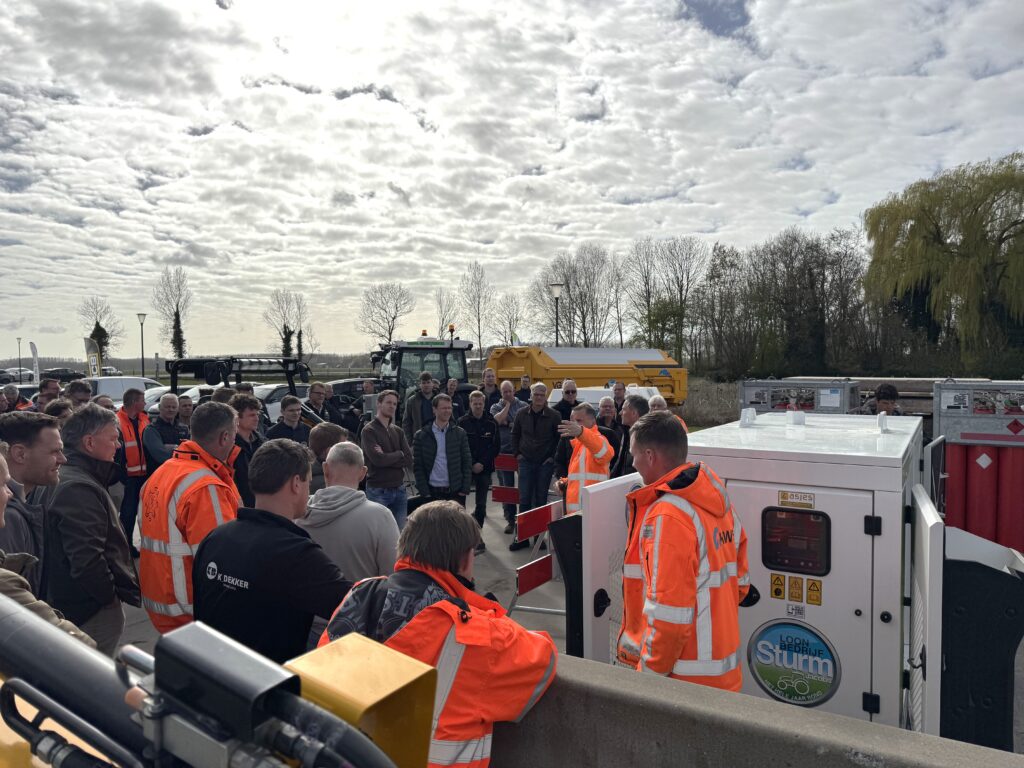
The MOOSE Powerunit has been designed for industries where electrification is proving difficult, particularly construction, infrastructure and agriculture. While electric machinery is becoming increasingly available, many worksites still lack sufficient grid capacity. At the same time, emission regulations are becoming stricter, forcing contractors to reduce diesel use while maintaining productivity.
The MOOSE addresses this challenge by acting as a mobile, high-capacity power station. Instead of relying on diesel generators or large battery containers, it generates electricity on-site from renewable methanol. “Think of it as a mobile fast-charging station,” says Bakker. “Besides charging multiple heavy machines simultaneously, the unit can also provide electricity for complete construction sites, temporary installations or even large outdoor events.”
Renewable Methanol Instead of Hydrogen Storage
Although hydrogen plays an important role inside the system, NGM has deliberately chosen renewable methanol as its energy carrier. The process begins inside a reformer, where liquid methanol is converted into a hydrogen-rich gas. That gas flows directly into a fuel cell stack, where hundreds of fuel-cell plates efficiently convert it into electricity with almost no noise. The only by-products are water vapour and usable heat. There are no particulate emissions, nitrogen oxides or other harmful exhaust gases.
According to Bakker, the real innovation lies in combining the reformer with a specially designed fuel-cell system. “Most fuel cells require extremely pure hydrogen. Our technology is different. It performs efficiently with a less purified hydrogen-rich gas, eliminating several expensive purification steps. That makes the entire system simpler, more robust, more cost-effective and highly reliable.”
Developed Together with Fraunhofer
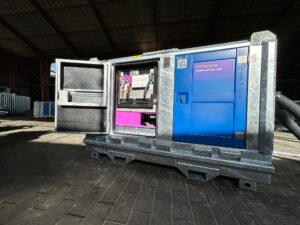 To develop the methanol reformer, NGM works closely with the Fraunhofer Institute in Germany, one of Europe’s leading research organisations in fuel-cell technology and methanol-to-hydrogen conversion. The collaboration focuses on optimising the reformer while validating every individual module before integrating the complete system. “We test every component independently before assembling the full power unit,” Bakker explains. “That step-by-step approach gives us confidence that the commercial product will perform reliably under demanding field conditions.”
The timing is favourable. Across Europe, contractors increasingly face stricter emission standards, nitrogen restrictions and requirements for zero-emission construction. At the same time, electricity grid congestion is delaying projects, while transporting large battery systems remains expensive and logistically complex.
According to Bakker, batteries alone are not always the answer. “To deliver the same amount of energy, battery systems can require up to twenty-five times more transport movements than diesel fuel. That’s simply not practical for many heavy-duty applications.” Because renewable methanol is a liquid fuel, it can be transported, stored and refuelled using infrastructure that is already familiar to operators.
Compared with compressed hydrogen, methanol also offers practical advantages. Hydrogen storage typically requires pressures of 350 to 700 bar, demanding heavy cylinders, complex logistics and higher costs. Renewable methanol avoids those challenges while still enabling carbon-neutral electricity generation when produced from sustainable feedstocks such as biomass or biogas.
Built In-House
Bakker proudly describes the engineering challenge as “Champions League technology.” Earlier prototypes relied heavily on commercially available components. The MOOSE Powerunit represents a major step forward, with NGM developing its own integrated system architecture. “This is essentially version zero of our own power platform,” he says. “Our ambition is to become a leading specialist in this technology over the coming years.”
The result is a compact generator that combines high output, low noise and zero harmful emissions in a package suitable for demanding industrial environments.
Opportunities Beyond Construction
NGM is also exploring applications outside the construction sector. The company participates in Fieldlab Hydrogen in Agri, a collaborative innovation programme where businesses, researchers and public partners develop practical solutions for hydrogen and sustainable energy carriers in agriculture and heavy logistics. (View project overview)
Although NGM does not produce or distribute hydrogen itself, the fieldlab provides valuable opportunities to test how the technology can contribute to more sustainable farming. The MOOSE functions as a clean combined heat and power (CHP) system. Besides generating electricity, it produces usable heat and a stream of clean CO₂ that can potentially be utilised directly in greenhouse horticulture without extensive flue-gas cleaning.
Its near-silent operation also makes it attractive for applications such as overnight irrigation, where conventional diesel generators often cause noise disturbance. The fieldlab has also created valuable partnerships. One example is Avia Marees, which is investigating future distribution of renewable methanol for the MOOSE units. “The network is incredibly inspiring,” Bakker says. “We exchange knowledge every month, and those conversations regularly lead to new collaborations.”
Looking for Pilot Partners
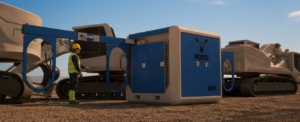 Following final validation, the first operational MOOSE Powerunit is expected to enter real-world operation later this year.NGM will then launch a series of pilot projects to demonstrate both the technology and its commercial viability. The company is currently seeking innovative contractors, civil engineering companies and agricultural contractors willing to operate the unit under real working conditions for a minimum of two weeks.
Participants will not be charged development costs. Instead, they pay only a competitive electricity price while gaining early access to one of the most advanced off-grid power solutions currently under development. For NGM, these pilots are essential for gathering operational data and preparing for large-scale market introduction. For participating companies, they offer an opportunity to experience quiet, emission-free power while helping shape the future of heavy-duty electrification.
As pressure grows to reduce emissions without compromising productivity, technologies such as the MOOSE Powerunit may provide a practical pathway toward cleaner construction, agriculture and infrastructure, without waiting for the electricity grid to catch up.
Interested in learning more or contacting NGM? All contact details are available via this link.